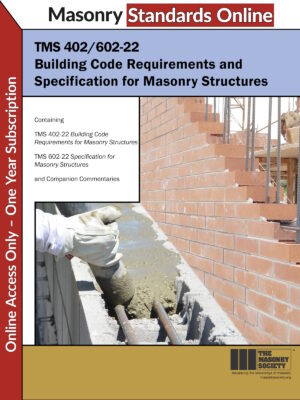
Bundle a TMS 402/602 hard copy with the download version to receive a 40% discount on the download (the discount will be applied after adding both items to your cart).
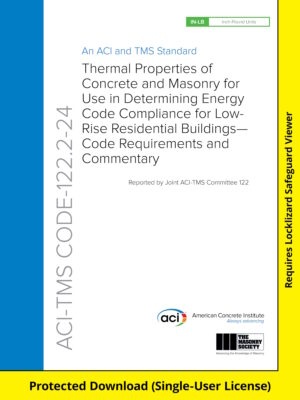
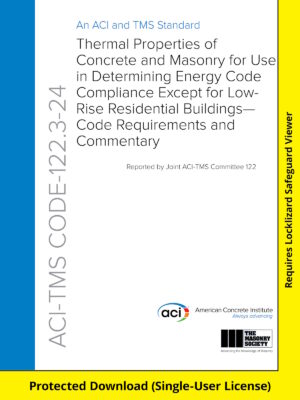
This Code prescribes minimum design and construction requirements for energy efficiency of building envelopes of new buildings and additions to buildings. It applies to buildings having concrete walls, roofs, or floors; masonry walls; and masonry veneer, including veneer attached to frame walls as part of the building envelope. It also provides minimum thermal properties for these assemblies for code compliance. This Code is applicable to low-rise residential buildings that use either electricity from any generation source or fossil fuel. It can be used with applicable energy codes and standards such as the International Energy Conservation Code (IECC).
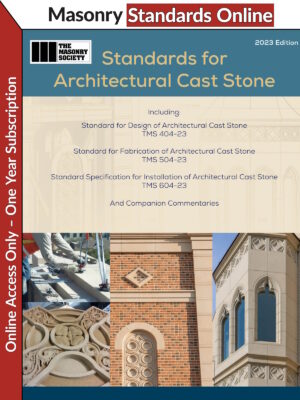
Standards for Architectural Cast Stone contains three standards and their commentaries:
Standard for Design of Architectural Cast Stone (TMS 404)
Standard for Fabrication of Architectural Cast Stone (TMS 504)
Standard Specification for Installation of Architectural Cast Stone (TMS 604)
Key updates and revisions incorporated by the Committee include:
Updates for coordination with other reference standards including updates to reflect changes in ASTM standards and reference to the 2022 edition of ASCE/SEI 7.
General cleanup and clarification of provisions and expanded commentary.
Introduced new deflection limits of l/600 for cast stone subjected to out-of-plane loads.
Removed the historical drying shrinkage limit of 0.000325, replaced by a requirement that drying shrinkage be tested and reported.
Minimum thickness requirement of 2.5 inches (64 mm) for all cast stone units.
Permitting the use of glass fiber reinforced polymer bars meeting ASTM D7957/C7957M.
Minimum qualifications for testing labs and inspection agencies are required to be defined
The TMS 302 Sound Standard provides minimum requirements for rating masonry walls for sound transmission class (STC) and outdoor-indoor transmission class (OITC) based on testing calibrated calculation procedures.
Topics covered include reference standards, definitions and notations, materials, construction, and methods to STC and OITC rating for concrete masonry and clay masonry assemblies.
TMS 302-18 is adopted by reference in the 2021 International Building Code.
Available through Masonry Standards Online thanks to the support of
The Masonry Society Journal is an open forum for the presentation and discussion of masonry research and as such, welcomes papers related to the field. The following papers are included in Volume 42.
Laboratory Testing of Historic Mortars: Part 1 – A Close Look to a 200-year-old Historic Clay-Lime Mortar
Laboratory Testing of Historic Mortars: Part 2 – Microstructure of a Historic Feebly-Hydraulic Lime Mortar Containing Silica Flour
Canada/US (CANUS) Collaborative Project Papers
Comparison of Reinforced Masonry Design: Project Overview and Design Examples
Comparison of Masonry Beam Design and Detailing Provisions
Comparison of Out-of-Plane Reinforced Masonry Wall Design Provisions
Comparison of Reinforced Masonry Shear Wall and Seismic Design Provisions
A Harmonization of Canadian and American Masonry Structures Design Standards
Funding for this project was provided jointly by the National Concrete Masonry Association Education and Research Foundation, the Canada Masonry Design Centre, the Canadian Concrete Masonry Producers Association, and the Canadian Standards Association.
This Code prescribes minimum design and construction requirements for energy efficiency of building envelopes of new buildings and additions to buildings. It applies to buildings having concrete walls, roofs, or floors; masonry walls; and masonry veneer, including veneer attached to frame walls as part of the building envelope. It also provides minimum thermal properties for these assemblies for code compliance.
This Code is applicable to commercial and mid- to high-rise residential buildings that use either electricity from any generation source or fossil fuel. It can be used with applicable energy codes and standards such as ASHRAE 90.1 and the International Energy Conservation Code (IECC).
This Standard provides minimum requirements for rating masonry walls for a sound transmission class (STC) and outdoor-indoor transmission class (OITC) based on field or laboratory testing or based on a calculation procedure.
The Standard is written as a legal document in mandatory language so that it may form a part of a legally adopted building code. The Commentary presents background details, committee considerations, and research data used to develop the Standard. Separate equations for clay and concrete masonry walls are used to reflect the varying properties of these materials related to sound transmission.
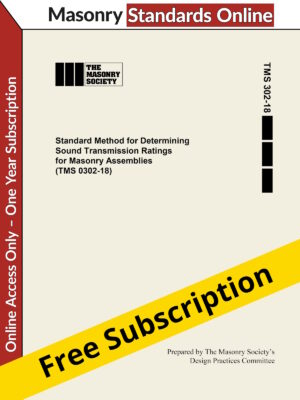 TMS 302-18 Standard Method for Determining Sound Transmission Ratings for Masonry Assemblies Online – Annual Subscription