The 13th North American Masonry Conference (NAMC) was held June 16–19, 2019 in Salt Lake City, Utah. The Conference is hosted by Brigham Young University and is one in a series of quadrennial conferences sponsored by The Masonry Society. This USB drive contains the 158 papers that were presented at the Conference.
This program is intended for any Owner, Architect, Engineer or Contractor who is assessing/purchasing/stabilizing/renovating an existing (especially an historic) building with masonry wall (including load-bearing/non-load-bearing/veneers) such as brick. stone or concrete masonry units. This program will specifically provide attendees with the fundamental skills necessary to understand how the following impact existing masonry structures:
Differing Architectural Approaches to Historical Restorations
Structural Functions of Masonry Walls
Building Code Evaluations of Existing Buildings
Investigation Techniques and Standards
Mortar Repointing and Crack Repair Techniques
Retrofit Veneer Anchor System
Lateral Restraint Anchors and Bracing Systems
This program was presented on April, 12, 2013 at the University of Texas – Brownsville Campus. Speakers include Alan Pettingale, Andreas Stavridis, Benchmark Harris, Michael Schuller, and Gordon Shepperd. The recordings listed below can be purchased individually or together at a 25% discount. Parts 1 & 14 are available for free.
Behavior of Masonry Mortar Containing a Non-Harmful Antifreeze Admixture
By: Ouafi Saha, Moh Boulfiza, and Leon D. Wegner
Corrosion-Based Service Life Analysis for Adhered Masonry Cladding Systems in Canada
By: Yasser Korany and Mark D. Hagel
Experimental Testing of Out-Of-Plane Capacity of Semi-Interlocking Masonry Infill Panels
By: Orod Zarrin, Yuri Z. Totoev, and Mark J. Masia
Masonry Giants – Presented During Daniel P. Abrams Masonry Giants Session A Ten-Year Multi-Phase Research Program on the Seismic Response of Reinforced Concrete Block Shear Wall Components and Systems
By: Mohamed Ezzeldin and Wael El-Dakhakhni
General Interest Papers
Determination of Projected Tension and Shear Area for Anchor Bolt Groups in Masonry
By: Richard M. Bennett
25 Years Later – The Northridge California Earthquake, It’s Impact on Masonry and TMS’s Response
By: Phillip J. Samblanet
$10.00Original price was: $10.00.$0.00Current price is: $0.00.
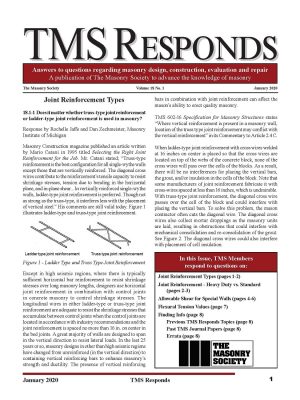
TMS Responds is a resources developed to help answer common, and sometimes, not so common questions on masonry materials, design, construction, evaluation, and repair.
Vol. 18, No. 1 (January 2019), responds to questions on:
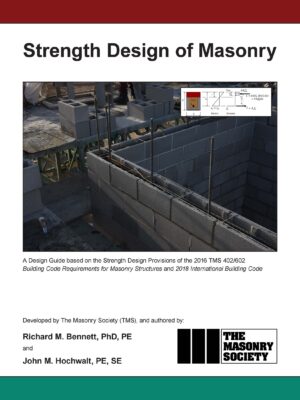
Topics addressed include an introduction to strength design concepts, background on structural masonry, general design, requirements for reinforcement and anchor bolts, and recommendations for construction. Also discussed are strength design procedures for beams, walls, columns, and shear walls. While the guide addresses unreinforced masonry, the primary focus is reinforced masonry designed to the TMS 402/602-16 and the 2018 International Building Code. The book contains dozens of design examples and design tips, coupled with excellent discussion.
The authors — Dr. Richard Bennett, a Professor at the University of Tennessee, and Mr. John Hochwalt, Director of Engineering at KPFF Engineers — both actively serve on the committee responsible for TMS 402/602, which contains requirements for strength design of masonry.
Topics addressed include an introduction to strength design concepts, background on structural masonry, general design, requirements for reinforcement and anchor bolts, and recommendations for construction. Also discussed are strength design procedures for beams, walls, columns, and shear walls. While the guide addresses unreinforced masonry, the primary focus is reinforced masonry designed to the TMS 402/602-16 and the 2018 International Building Code. The book contains dozens of design examples and design tips, coupled with excellent discussion.
The authors — Dr. Richard Bennett, a Professor at the University of Tennessee, and Mr. John Hochwalt, Director of Engineering at KPFF Engineers — both actively serve on the committee responsible for TMS 402/602, which contains requirements for strength design of masonry.
The Masonry Society Journal is an open forum for the presentation and discussion of masonry research and, as such, welcomes papers related to the masonry field. All material submitted for publication will be reviewed according to TMS Journal policy, a description of which appears at the end of each issue. All technical materials appearing in the Journal may be discussed, and discussion of papers will be published along with the author’s replies.
TMS Journal is indexed and abstracted in Emerging Sources Citation Index by Clarivate Analytics.
Journals are published yearly, typically in December or January.
The Masonry Society Journal is an open forum for the presentation and discussion of masonry research and, as such, welcomes papers related to the masonry field. All material submitted for publication will be reviewed according to TMS Journal policy, a description of which appears at the end of each issue. All technical materials appearing in the Journal may be discussed, and discussion of papers will be published along with the author’s replies.
TMS Journal is indexed and abstracted in Emerging Sources Citation Index by Clarivate Analytics.
Journals are published yearly, typically in December or January.
$10.00Original price was: $10.00.$0.00Current price is: $0.00.
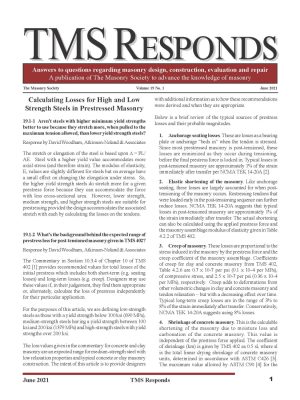
TMS Responds is a resources developed to help answer common, and sometimes, not so common questions on masonry materials, design, construction, evaluation, and repair.
Vol. 19, No. 1 (June 2021), responds to questions on:
Calculating Losses for High and Low Strength Steels in Prestressed Masonry
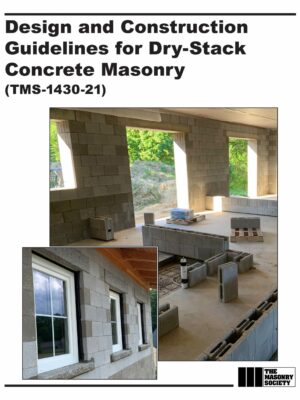
This guide covers the design and construction of dry-stack concrete masonry structures constructed from hollow units. Among the subjects covered are history and background, fire resistance, design, construction, quality assurance, materials, surface-bonding, placement of embedded items, analysis, strength and serviceability, flexural and axial loads, shear, details and development of reinforcement, walls, and seismic design requirements.
Dry-stack masonry construction, which consists of individual masonry units placed without the use of mortar in the head and bed joints, is one of the earliest forms of construction. Despite its historical use, there is little in the way of contemporary design and construction guidance in the United States on the use of dry-stack masonry systems for structural applications. Because the majority of dry-stack research has been limited to reinforced or prestressed concrete masonry construction, the scope of this guide is limited to reinforced or prestressed, dry-stack construction of concrete masonry units.
Design and Construction Guidelines for Dry-Stack Concrete Masonry was developed as a non-mandatory aid for designers, building officials, contractors, educators, and others interested in dry-stack masonry construction.
Dry-stack masonry construction, which consists of individual masonry units placed without the use of mortar in the head and bed joints, is one of the earliest forms of construction. Despite its historical use, there is little in the way of contemporary design and construction guidance in the United States on the use of dry-stack masonry systems for structural applications. Because the majority of dry-stack research has been limited to reinforced or prestressed concrete masonry construction, the scope of this guide is limited to reinforced or prestressed, dry-stack construction of concrete masonry units.
This code prescribes minimum design and construction requirements for mitigating thermal bridges in the building envelopes of new buildings and additions to existing buildings. It applies to buildings having concrete or masonry walls; masonry veneer, including veneer attached to frame walls; and balconies or components that extend through the building envelope. It also has criteria for metal thermal bridges in these buildings.
This code is applicable to commercial and mid- to high-rise residential buildings that use either electricity or fossil fuel (regardless of the generation source). It can be used with applicable energy codes and standards.
The Reinforced Concrete Masonry Construction Inspector’s Handbook, 11th Edition, covers all aspects of reinforced concrete masonry construction and inspection. The materials are based on Code requirements and practical experience. The 11th edition incorporates the requirements of the 2021 International Building Code; the 2016 Building Code Requirements for Masonry Structures (TMS 402-16) and Specification for Masonry Structures (TMS 602-16).
This nationally recognized publication is the primary source of information for understanding the material required for the Structural Masonry Inspection Certification Exam administered by ICC. Every inspector, designer, and contractor should have a copy of this important publication.
TMS 402/602-22 Building Code Requirements and Specification for Masonry Structures contains two standards and their commentaries: Building Code Requirements for Masonry Structures (TMS 402-22) and Specification for Masonry Structures (TMS 602-22). The Code (TMS 402) covers the design and construction of masonry structures while the Specification (TMS 602) is concerned with minimum construction requirements for masonry in structures.
The new 2022 edition has been updated throughout for new referenced standards, including ASCE/SEI 7-22 and numerous ASTM Standards. Other major changes to the TMS 402/602-22 include:
New, more rational, masonry veneer provisions
New Appendix D on composite reinforcement in masonry
Updated and refined provisions throughout, including compression-controlled section requirements
Bundle a TMS 402/602 hard copy with the download version to receive a 40% discount on the download (the discount will be applied after adding both items to your cart).
Online Subscription Access
Available online with improved features (copy, print, highlight, annotate, and more) plus more multi-user flexibility through Masonry Standards Online.
TMS Members – 50% off all subscriptions + multi-user discounts Non-Members – 40% off an annual subscription by adding it to your cart along with a hard copy or download
 TMS Responds, Vol. 1 No. 2
  TMS 402/602-13 Building Code Requirements and Specification for Masonry Structures (MSJC 2013)
  TMS eJournal, Vol. 39, No. 1
  TMS 402/602-22 Online - Annual Subscription
  Masonry Course Notes (Based on the 2013 TMS 402/602)
  Reinforced Concrete Masonry Construction Inspector’s Handbook, Eleventh Edition